Quick answer: SEO (search engine optimization) is improving how a website is found and chosen in search engines. AEO (answer engine optimization) aims at direct answers, such as featured snippets, voice results and now AI answers. GEO (generative engine optimization) aims at answers written by AI tools like ChatGPT or Google’s AI Mode. In practice they overlap heavily, and Google treats both AEO and GEO as SEO.
The three terms are often sold as three separate services. They are better understood as three names for different angles on one job. Here is where each came from, how the major platforms use them and which claims to be careful with.
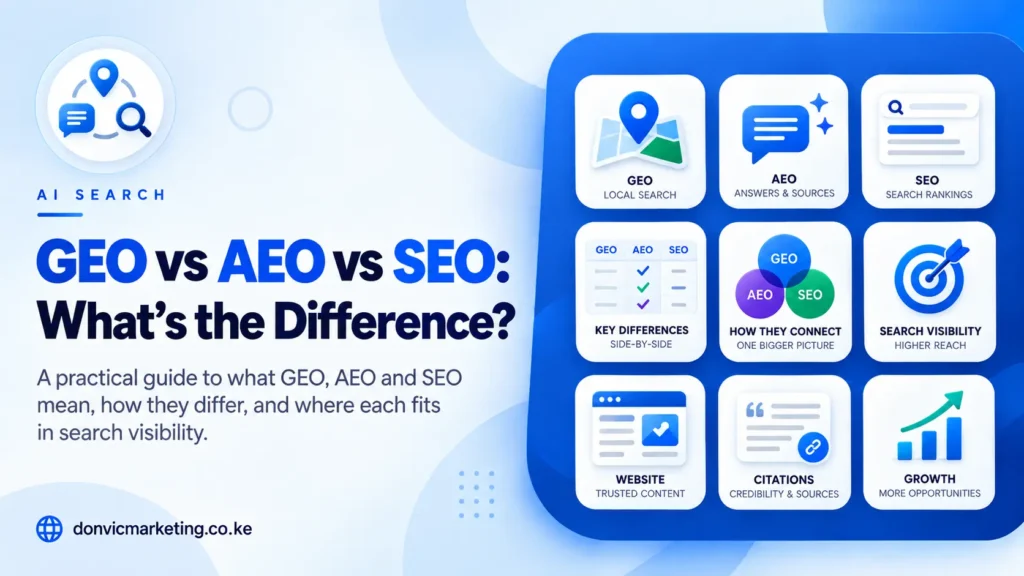
The Three Terms, Defined
| Term | Stands for | Aims at | Where the term comes from |
| SEO | Search engine optimization | Being found and chosen in search results | The established name for the discipline since the 1990s |
| AEO | Answer engine optimization | Being the source of a direct answer | Used before generative AI for featured snippets and voice assistants; now stretched to AI answers |
| GEO | Generative engine optimization | Being used and cited in AI-written answers | A 2023 research paper on AI-generated search answers |
A few other labels float around as well: AI SEO, AI search optimization, LLM optimization (LLMO) and AIO. They describe the same area as GEO. We use “AI search optimization” because it says what it means without an acronym, and our explainer on what AI search optimization is defines it in full.
Where GEO Came From
GEO has a specific origin. A group of researchers including Pranjal Aggarwal, Ameet Deshpande and Karthik Narasimhan published a paper titled GEO: Generative Engine Optimization in November 2023, later accepted to the KDD 2024 conference. They built a test set of queries, called GEO-bench, and measured how changes to source content affected its visibility in AI-generated answers. They reported improvements of up to 40% on that benchmark.
Two things follow. First, GEO began as a research framework, not a service category. Second, the 40% figure describes a controlled experiment, not a result anyone can promise you on ChatGPT or Google today.
Where AEO Came From
AEO predates the current wave of AI. It was used for work aimed at featured snippets, “People also ask” boxes and voice assistants, where a search engine reads out or displays one answer. The same habits apply to AI answers: answer the question directly, early and accurately.
Where the Terms Overlap
Put the three side by side and most of the work is shared.
| Activity | SEO | AEO | GEO |
| Make pages crawlable and indexable | Yes | Yes | Yes |
| Write helpful, original content | Yes | Yes | Yes |
| Answer questions clearly and early | Yes | Central | Central |
| Build authority and a trustworthy reputation | Yes | Yes | Yes |
| Structured data that matches the page | Yes | Yes | Useful, not required |
| Allow AI search crawlers such as OAI-SearchBot | Increasingly | Yes | Yes |
| Measure AI citations and impressions | Increasingly | Yes | Yes |
The differences are of emphasis, not method. That is also why an SEO provider who is doing good work is already doing most of what AEO and GEO describe. Our comparison of AI SEO and traditional SEO lists the five things that do shift.
How Google and Microsoft Use the Terms
The two largest search companies take noticeably different positions on the vocabulary, though not on the substance.
Google addresses the terms directly in its guide to generative AI features: “From Google Search’s perspective, optimizing for generative AI search is optimizing for the search experience, and thus still SEO.” It adds that if you are considering third-party AEO or GEO advice or services, you should review its guidance on evaluating SEO advice. The same guide has a section titled “what you don’t need to do”, aimed squarely at popular GEO tactics.
Microsoft is more comfortable with the label. When it launched AI Performance in Bing Webmaster Tools in February 2026, it described the report as “an early step toward Generative Engine Optimization (GEO) tooling”. The report counts how often your pages are cited in Copilot and Bing’s AI answers.
So one company says “it is all SEO” and the other builds “GEO tooling”. Both are describing the same thing: whether your content gets used in AI answers. The advice from both still starts with pages that can be crawled, indexed and trusted.
See the framework behind all three terms. Our AI search optimization guide sets out the four conditions a page must meet to be cited, and a 90-day plan.
What a Business Actually Needs to Buy
If you are being offered SEO, AEO and GEO as three services, here is how to think about it. You need one programme that covers:
- Technical access for Google, Bing and the AI search crawlers, including your firewall and CDN
- Content that answers real customer questions with specifics
- Reputation and consistency: reviews and business details that agree across the web
- Reporting that includes Search Console’s Generative AI performance report and Bing’s AI Performance report
That is one scope of work. Whether it is invoiced as SEO, AEO or GEO matters much less than whether each part is done. At Donvic, it sits inside our SEO service with no separate fee, as our AI search optimization page explains.
Claims to Be Wary Of
These claims appear often in GEO and AEO sales material. Each is checked against what the platforms themselves have published.
“We guarantee you will appear in ChatGPT.” No platform offers this. Google says indexing and serving are never guaranteed even when every requirement is met.
“You need an llms.txt file.” Google says its Search ignores llms.txt and similar files. They neither help nor harm Google visibility. Other services may read them, which is a separate and much smaller question.
“We add AI schema.” Google states there is “no special schema.org structured data” needed for AI features. Ordinary structured data that matches your page is still worthwhile.
“We chunk your content for AI.” Google lists breaking content into small pieces as unnecessary, saying its systems understand pages with several topics.
“We will get you mentioned on hundreds of sites.” Google warns that seeking inauthentic mentions “isn’t as helpful as it might seem”, and spam systems filter it out.
“Our tool shows your ranking inside Google’s AI.” Google says no third-party tool has access to its internal ranking or AI systems. Tools that run sample prompts can be useful signals, but they are not Google’s data.
“We will create a page for every question.” Google treats pages made mainly to capture query variations as scaled content abuse. See our explainer on query fan-out for why broad coverage belongs on strong pages, not hundreds of thin ones.
If you are comparing providers, our guide to AI SEO agencies in Kenya suggests questions to ask, and our 10 ways to improve AI search visibility shows what legitimate work looks like.
Frequently Asked Questions
What is the difference between GEO and SEO?
SEO is the broad practice of being found in search. GEO focuses on being used and cited in answers written by AI tools. GEO relies on the same foundations as SEO, and Google considers it part of SEO.
Is AEO the same as GEO?
They overlap heavily. AEO started with featured snippets and voice answers; GEO came from 2023 research on AI-written answers. Both aim to make your content the source of an answer, and the practical work is largely the same.
Does Google use the term GEO?
Google mentions GEO and AEO in its guidance only to say that, from its perspective, optimising for generative AI search is still SEO. Microsoft uses GEO more readily and describes its Bing AI Performance report as early GEO tooling.
Do I need a GEO agency as well as an SEO agency?
Usually not. Ask your SEO provider whether they check AI crawler access, read the Generative AI performance report and keep your business facts consistent. If they do, you are already covered.
Where did the term generative engine optimization come from?
From a 2023 research paper, GEO: Generative Engine Optimization, by researchers including Pranjal Aggarwal and Karthik Narasimhan. It was accepted to the KDD 2024 conference and reported visibility gains of up to 40% on its own benchmark.
One Job, Three Names
Call it SEO, AEO or GEO: the work is making good pages reachable, clear and trusted, and then measuring what happens. If you would like that done for your business, tell us about your site or call 0741 312 101.