TL;DR: AI search optimization is the practice of helping your website get found, understood and cited by AI search tools such as Google’s AI Overviews and AI Mode, ChatGPT search, Microsoft Copilot and Perplexity. It covers crawler access, indexing, content specific enough to quote and consistent information about your business. Google treats it as part of SEO, not a separate discipline.
The term causes more confusion than it should, mostly because it arrived with several names at once and a lot of people selling each one. This article gives you a working definition, shows what the job actually consists of and, just as useful, what it cannot do.
A Working Definition
Here is the definition we use with clients:
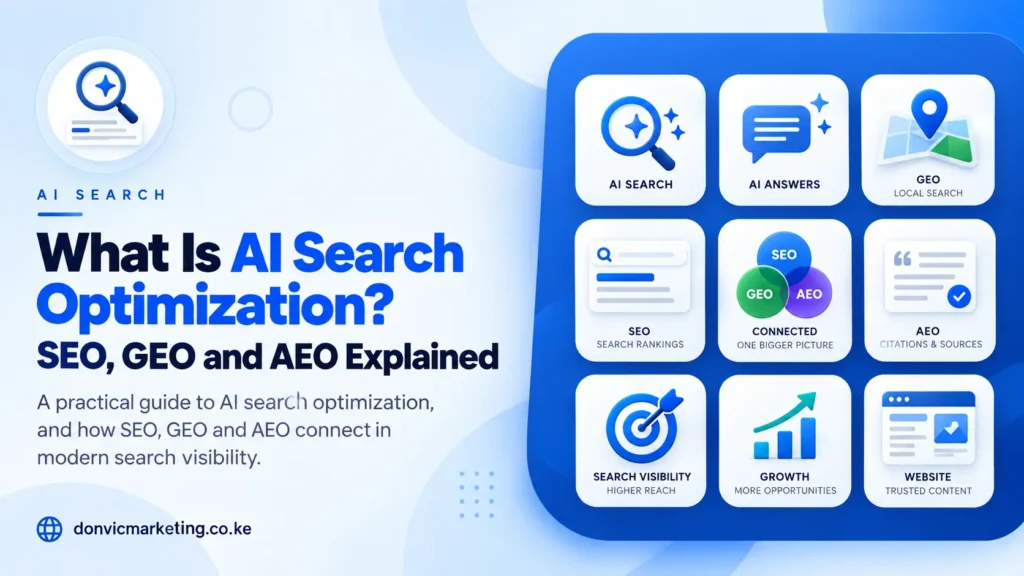
AI search optimization is SEO work aimed at the moment an AI tool reads the web on someone’s behalf and decides which sources to show.
Three things are packed into that sentence.
It is SEO work. Google’s guide to generative AI features says AI Overviews and AI Mode are “rooted in our core Search ranking and quality systems”, and that optimising for them is “still SEO”. Microsoft’s Copilot draws on the Bing index in the same way.
An AI tool reads the web on someone’s behalf. Instead of scanning ten blue links, the person gets a written answer. The tool has searched, read several pages and summarised them.
It decides which sources to show. Most AI answers display a few supporting links or name a few businesses. Being among them is the outcome this work is aiming for.
Three Names for Overlapping Work
You will see the same idea described in three ways:
- AI SEO or AI search optimization: the plainest description, and the one we use.
- GEO, generative engine optimization: a term from a 2023 research paper on improving visibility in AI-generated answers.
- AEO, answer engine optimization: a term in use before generative AI, when it mostly meant featured snippets and voice answers, now applied to AI answers.
They overlap almost completely in practice. Google’s own view is that it is all SEO, and it advises caution with third-party “AEO” or “GEO” services. If you want the history and the fine distinctions, our guide to GEO vs AEO vs SEO covers them. For the purposes of hiring someone or planning work, treat the three as one job.
What AI Search Tools Actually Look At
Before deciding what to optimise, it helps to know what the tools use. In broad terms, an AI search tool looks at:
- Pages in its search index. Google uses its Search index. Copilot uses Bing’s. ChatGPT search relies on OpenAI’s search systems, fed by its OAI-SearchBot crawler. If your page is not in the relevant index, it is not a candidate.
- The text on those pages. Answers are written from what the page says in readable text: prices, steps, definitions, opening hours, service areas.
- Signals about the source. The same quality and trust systems that rank normal results. Google also notes that AI features can reflect what is said about businesses across the web.
- Business listings and product feeds. Google says Merchant Center and Business Profile information can feed product and local details into AI responses.
Our guide to how AI search engines find, retrieve and cite websites goes through this sequence step by step.
What the Work Involves
Because the tools use those four inputs, the work falls into four matching areas.
| Area | Typical tasks |
| Access | Allow Googlebot, Bingbot, OAI-SearchBot and PerplexityBot in robots.txt, the CDN and the firewall. Confirm the Search generative AI setting in Search Console includes your site |
| Content | Put the specifics customers ask about on your pages: prices, processes, timeframes, locations and first-hand detail |
| Business facts | Keep name, services, location, hours and contact details identical across your site, Google Business Profile and directories. Earn genuine reviews |
| Measurement | Read the Generative AI performance report in Search Console, Bing’s AI Performance report and AI referral visits in GA4 |
None of these is exotic. A good SEO programme already does most of it. The difference is emphasis: more crawlers to check, more weight on factual consistency and new reports to read. Our comparison of AI SEO and traditional SEO lists exactly what shifts. For a working checklist, see our 30 AI search optimization checks.
Want the work done rather than read about? AI search optimization is part of every Donvic SEO package. See what is included.
What It Cannot Do
This part is often left out of sales pitches, so it is worth stating clearly.
It cannot guarantee a citation. Google says that even when a page meets every requirement, “indexing and serving isn’t guaranteed”. No other platform offers more certainty.
It cannot control what the answer says. You can make accurate information easy to find. The model still writes the summary.
It cannot make up for a weak offer. If competitors have more reviews, clearer prices and better pages, an AI answer will tend to reflect that, just as a normal results page would.
It cannot be measured perfectly. Google’s AI report shows impressions but not clicks separately. ChatGPT and Perplexity offer no site owner report at all. You will be working with partial data, and an honest provider says so.
It cannot be done with shortcuts. Google lists things you can ignore, including llms.txt files, “chunking” content into small pieces and special AI markup. It also warns that mass-producing pages for every question variation breaches its spam policies.
An Example, Start to Finish
This is an illustrative example, not a client case.
A physiotherapy practice in Kilimani wants to appear when people ask AI tools for home physiotherapy in Nairobi.
- Access. The practice checks its robots.txt and finds nothing blocked, but its hosting firewall challenges unknown bots. It allows the four search crawlers.
- Eligibility. In Search Console, its services page is indexed and the Search generative AI setting shows “include”.
- Content. The services page said “we offer home visits”. It now states which estates are covered, what the first visit includes, how long it lasts and the fee.
- Facts. The Business Profile showed old hours and a previous phone number. Both are corrected, and a directory listing with the old address is updated.
- Measurement. A month later the practice compares its Generative AI performance report and GA4 referrals against the starting point.
Nothing in that list is a trick. That is the point.
Frequently Asked Questions
What is AI search optimization in simple terms?
It is making your website easy for AI search tools to find, understand and quote. That means letting their crawlers in, getting your pages indexed, stating clear facts on your pages and keeping your business details consistent everywhere.
Is AI search optimization the same as SEO?
Largely yes. Google says optimising for its AI features is still SEO. The additions are more crawlers to manage, closer attention to consistent business facts and new AI reports to read.
What does GEO mean in marketing?
GEO stands for generative engine optimization. It describes improving visibility in answers written by AI tools. The term comes from a 2023 research paper, and in practice it overlaps almost entirely with SEO.
Can small businesses in Kenya benefit from AI search optimization?
Yes, particularly local businesses. The most useful steps, such as fixing crawler access, stating prices and service areas and keeping your Google Business Profile accurate, are inexpensive and help ordinary search at the same time.
How long does AI search optimization take to work?
Access and indexing fixes can show within weeks, once pages are recrawled. Content and reputation work takes months, in line with normal SEO. Our guide on how long SEO takes in Kenya sets realistic expectations.
Where to Go Next
If you want the whole picture, our complete AI search optimization guide sets out how the systems work and a 90-day plan. If you would like help, the work is part of our SEO service, from KES 30,000 a month.
Talk to us: send your website and your questions or call 0741 312 101.