Quick answer: Query fan-out is a technique Google’s AI Overviews and AI Mode use to answer a question by running several related searches at the same time, then combining what they find. For SEO, it means pages are judged on how well they cover the questions around a topic, not just one keyword. It does not mean you should create a page for every question: Google treats that as spam.
What Google Says Query Fan-Out Is
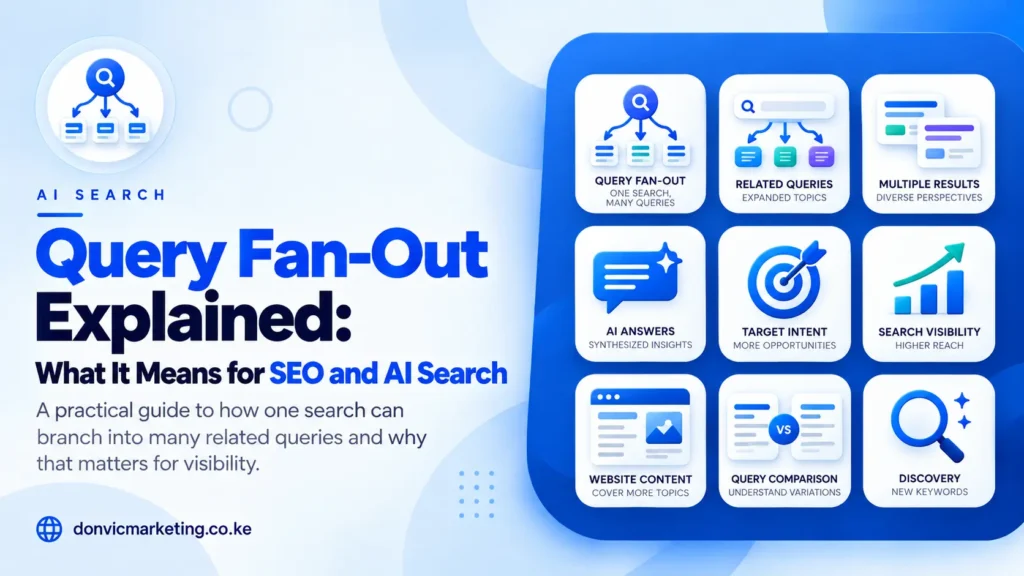
Google defines it in its guide to generative AI features as “a set of concurrent, related queries generated by the model to request more information and fetch additional relevant search results to address the user’s query.”
It gives an example. For the question “how to fix a lawn that’s full of weeds”, the fan-out searches might include:
- best herbicides for lawns
- remove weeds without chemicals
- how to prevent weeds in lawn
Google’s AI features page adds that both AI Overviews and AI Mode “may use” the technique, issuing “multiple related searches across subtopics and data sources”, and that this lets them show “a wider and more diverse set of helpful links” than a classic search.
Two points are worth holding on to. First, the fan-out searches are generated by the model; you cannot see them, and Google does not publish them for your site. Second, each fan-out search runs through Google’s normal ranking systems. The pages retrieved are the ones that would have done well for that sub-question anyway.
One Question, Broken Apart
To make this concrete, here is an illustration. Google does not publish real fan-out queries, so treat this as our reconstruction of the kind of thing that happens, not a record of it.
A parent in Nairobi asks AI Mode:
“Which beach hotel near Mombasa is good for a family with a toddler in April, and what is the easiest way to get there?”
A reasonable fan-out might look like this:
| Sub-question | What a useful page would need to say |
| family friendly beach hotels near Mombasa | Family rooms, cots, a shallow pool, a kids’ menu |
| Mombasa weather in April | That April falls in the long rains, and what that means for a beach stay |
| toddler safety at beach resorts Kenya | Pool fencing, lifeguards, medical support nearby |
| Nairobi to Mombasa with a toddler | Train and flight options, transfer times from the station or airport |
| beach hotel April offers Mombasa | Low season rates or packages, if they exist |
The final answer would draw on pages that answered those sub-questions well, possibly from several different websites.
Why a Single Keyword Page Falls Short
Imagine a hotel whose website has one page targeting “family hotel Mombasa”. It says the hotel is family friendly, shows a photo of the pool and has a booking button.
That page might rank for its keyword. But across the five sub-questions above, it answers almost nothing. It does not mention cots, pool fencing, April weather or how to get there. When the fan-out searches run, other sites answer those parts, and those sites are more likely to be cited.
Now imagine a hotel site with a detailed family page (rooms, cots, pool depth, supervision, kids’ menu), a clear “getting here” page with train, flight and transfer details, and an honest page about visiting in each season. The same fan-out finds this hotel for three or four of the five sub-questions. That is the practical effect of fan-out: coverage of the surrounding questions matters more than matching the headline phrase.
Planning content around real customer questions? We build topic maps for Kenyan businesses as part of our SEO work. Talk to us about your topics.
The Trap: A Page for Every Question
The obvious reaction is to create a page for each possible sub-question. Google explicitly warns against it.
Its guide says that creating “separate content for every possible variation of how people might search (for example, by focusing on other queries that people have asked, or fan-out queries)” primarily to manipulate rankings or AI responses “violates Google’s scaled content abuse spam policy”. It adds that “a high quantity of pages doesn’t make a website higher quality”.
Google also notes that its systems understand synonyms and meaning, so “you don’t have to worry that you don’t have enough ‘long-tail’ keywords or haven’t captured every variation.”
The balance is this: cover the questions that genuinely belong to a topic, on the pages where a reader would expect to find them. Answer “is April a good time to visit” on your seasons page, not on a new page titled “Is April a Good Time to Visit Mombasa Beach Hotels”. If a sub-question deserves a full article, because readers really do want depth on it, then write one and link to it.
Building a Site That Survives Fan-Out
Organise by Topic, Not by Phrase
Group your content into a small number of topics you want to be known for, each with one strong main page and a few supporting pages for sub-topics that need depth. This is the idea behind topic clusters. For a hotel, topics might be rooms and families, dining, getting here, seasons and weather, and activities.
Link the Pieces Together
Google’s AI features guidance lists “making your content easily findable through internal links” among the fundamentals. Link from each main page to its supporting pages and back, with anchor text that says what the reader will find. Our guide to internal linking covers the mechanics.
Answer Early, Then Go Deeper
Start each section with a direct answer, then give the detail. A section headed “Getting here from Nairobi” should say in its first two sentences what the options are and roughly how long each takes, then add the detail. This helps readers and makes the page useful for whichever sub-question retrieved it.
State the Specifics
Fan-out sub-questions tend to be specific: prices, times, distances, policies. Pages that state specifics in text give an AI answer something to use. Pages that say “contact us for details” do not.
Finding the Questions Around Your Topic
You cannot see Google’s fan-out queries, but you can find the questions your customers ask:
- Your inbox and WhatsApp. The questions customers ask before booking are the best list you will get.
- Search Console. Longer queries in the Performance report show how people phrase questions that already reach you.
- “People also ask” boxes for your main topics.
- Bing Webmaster Tools. Its AI Performance report shows a sample of “grounding queries”, the phrases Copilot used when retrieving your pages.
- Keyword research tools, used as our guide to local keyword research in Kenya describes.
Put the questions under the topics they belong to. Gaps become obvious quickly.
How This Fits With the Rest of AI Search
Fan-out is the retrieval stage of a longer process. Our guide to how AI search engines find and cite websites covers the full chain, and RAG and search grounding explains what happens after the pages are retrieved. For the full picture, start with our AI search optimization guide.
If you want help mapping your topics and filling the gaps, that work is part of our AI search optimization service, included in every SEO package.
Map your topics with us: send your website and the questions your customers ask most, or call 0741 312 101.